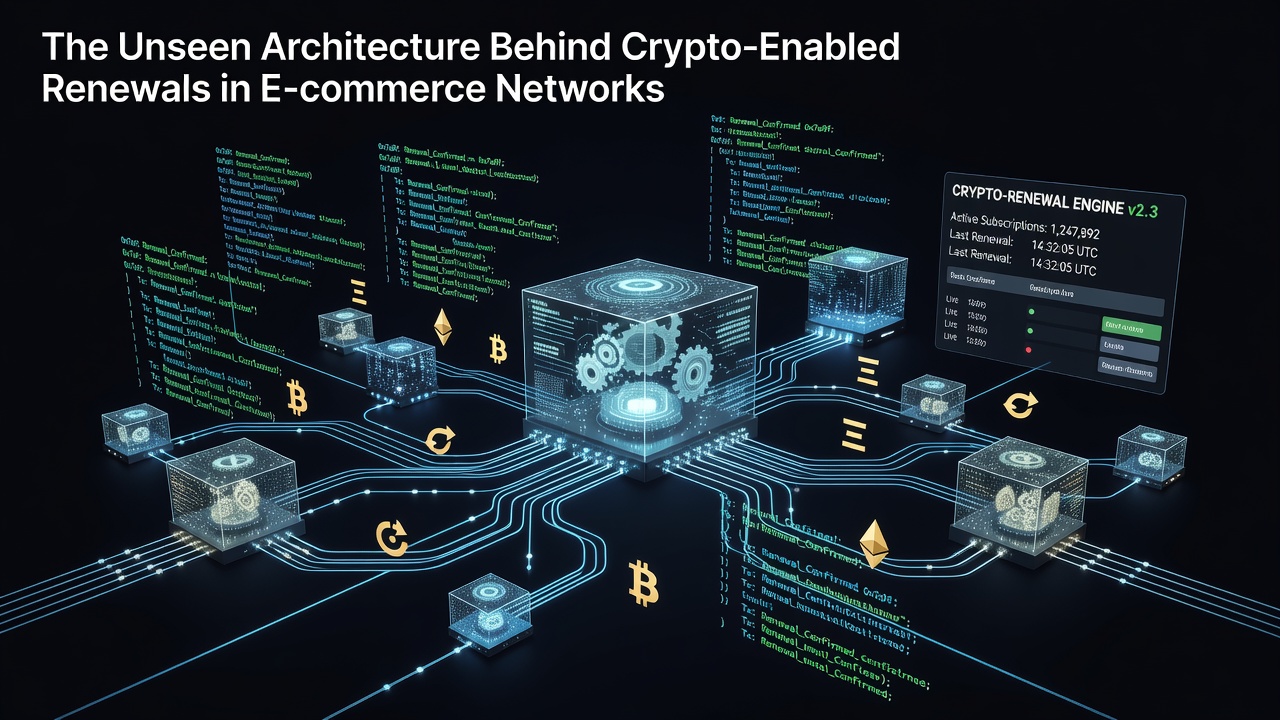
The Unseen Architecture Behind Crypto-Enabled Renewals in E-commerce Networks
Behind every seamless crypto-enabled renewal in online retail sits a layered infrastructure that coordinates distributed ledgers, smart contracts, and secure data pipelines without drawing attention to itself, while e-commerce platforms process recurring charges across global networks. Observers note that these systems rely on modular components working in tandem, where transaction validation occurs through consensus protocols rather than central authorities, and payment triggers activate automatically once predefined conditions in code are met.
Foundational Ledger Structures
Distributed ledger technology forms the base layer for these renewal flows, with nodes maintaining synchronized copies of transaction histories across multiple geographic regions, and each node participates in validating blocks that record subscription events. Research from academic institutions shows that permissioned blockchain variants often handle e-commerce use cases because they allow controlled access while preserving immutability for audit trails, whereas public chains provide broader transparency when merchants require it. Data indicates that by July 2026 transaction volumes for recurring crypto payments had increased steadily in several retail sectors, driven by integration with existing inventory and customer management databases.
Smart contracts sit atop these ledgers as self-executing scripts that encode renewal logic, including price adjustments based on external feeds and automatic deduction triggers tied to user wallet balances. Those who've examined production deployments find that oracles supply off-chain data such as exchange rates or inventory levels, ensuring contracts reflect real-time conditions without manual intervention from platform operators.
Gateway and API Integration Points
Payment gateways serve as the connective tissue between traditional e-commerce software and crypto networks, translating API calls from shopping carts into blockchain transactions that initiate renewals on schedule. Engineers design these gateways with fallback mechanisms so that if one node cluster experiences latency, traffic routes to alternate validators, maintaining uptime for merchants who cannot afford missed billing cycles. Figures from industry reports reveal that standardized interfaces now support multiple token standards, allowing platforms to accept various cryptocurrencies while reconciling them into unified accounting records.
Encryption protocols wrap these interactions at every stage, with end-to-end schemes protecting wallet keys during transmission and zero-knowledge proofs enabling verification of sufficient funds without exposing full account details. This approach aligns with guidelines issued by regulatory bodies such as the Bank for International Settlements, which track evolving standards for digital asset custody in commercial applications.

Validation and Scalability Mechanisms
Consensus algorithms determine how quickly renewal transactions finalize, and many implementations favor variants of proof-of-stake that reduce energy consumption compared with earlier models while still deterring malicious activity through economic incentives. Observers tracking network performance note that layer-two scaling solutions batch multiple micro-transactions before settling them on the main chain, which cuts fees and improves throughput for high-volume subscription services. Evidence suggests these optimizations have proven essential as e-commerce networks expand into regions with variable connectivity.
Monitoring dashboards track node health and transaction queues in real time, alerting operators to anomalies before they affect customer renewals, and automated scripts can spin up additional validator instances during peak periods such as product launches or seasonal promotions. Researchers at technical universities have documented how these adaptive clusters maintain consistency across borders, synchronizing state changes even when regulatory environments differ between jurisdictions.
Security and Compliance Layers
Multi-signature requirements and threshold encryption schemes add further safeguards, demanding coordinated approval from several parties before a renewal processes, which reduces single-point risks in vendor ecosystems. Compliance modules embed checks against sanctioned addresses and perform basic anti-money-laundering screening within the transaction pipeline itself, drawing on updated lists maintained by governmental agencies. One study from an Australian research center highlighted measurable reductions in dispute rates when such automated checks operate continuously rather than through periodic manual reviews.
Interoperability frameworks allow these architectures to connect with legacy payment rails when merchants offer hybrid options, converting crypto outputs into fiat settlements through regulated partners while preserving the original on-chain record for transparency. This hybrid capability supports gradual adoption without requiring complete replacement of existing infrastructure.
Conclusion
The unseen architecture supporting crypto-enabled renewals continues to evolve through incremental upgrades to node software, protocol refinements, and tighter integration with retail databases, creating resilient pathways for recurring commerce. Those monitoring developments in July 2026 observe steady maturation of these systems across diverse markets, with emphasis on reliability and regulatory alignment shaping future iterations. Data from multiple sources shows measurable progress in transaction reliability and cross-platform compatibility, underscoring the technical foundation that enables these networks to operate at scale.