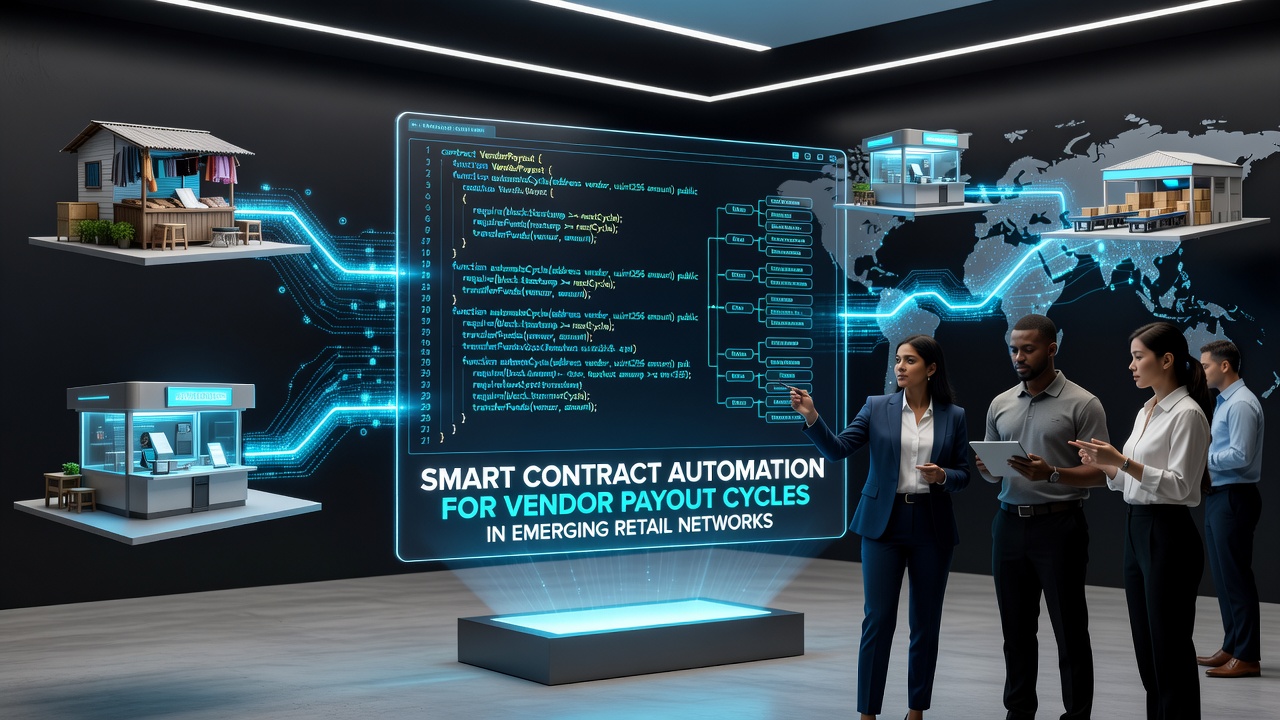
Smart Contract Automation for Vendor Payout Cycles in Emerging Retail Networks
Smart contract automation handles vendor payout cycles by encoding payment terms directly into blockchain protocols that execute transfers once predefined conditions receive verification from integrated data sources, and this approach appears across emerging retail networks where traditional banking infrastructure often lags behind transaction volumes in regions such as Southeast Asia, Latin America, and parts of Africa. Retail operators deploy these contracts on platforms including Ethereum and specialized enterprise chains, while oracles feed real-time inputs like delivery confirmations, inventory scans, and sales data into the system to release funds without manual intervention from finance teams.
Core Mechanisms Driving Automated Payouts
Each smart contract contains conditional logic that monitors multiple data streams simultaneously, and vendors receive compensation automatically when shipment tracking systems register arrival at distribution centers or when point-of-sale records confirm product movement to end consumers. Developers structure these agreements with multi-signature requirements or threshold approvals so that single-party errors cannot trigger erroneous disbursements, yet the entire sequence completes in minutes rather than the days or weeks associated with legacy invoice processing. Data indicates that transaction finality occurs on-chain with immutable audit trails, which supports compliance reporting for networks operating across multiple jurisdictions.
Adoption Patterns in Expanding Retail Ecosystems
Emerging retail networks integrate these tools to manage relationships with thousands of small suppliers who lack access to corporate banking services, and automated cycles reduce the administrative burden that previously required dedicated accounts payable staff at each hub. Research from institutions tracking digital trade finance shows increasing deployment in markets where mobile penetration exceeds traditional financial inclusion rates, allowing vendors to receive stablecoin or local currency equivalents directly into digital wallets linked to their business profiles. Observers note that synchronization between inventory management software and payout contracts minimizes disputes over quantities and quality because sensor data from IoT devices feeds directly into the verification layer.
Technical Integration Points
Retail platforms connect existing ERP systems to blockchain nodes through standardized APIs, while middleware layers translate conventional database entries into events that smart contracts can evaluate. Security audits conducted by independent firms examine the code for reentrancy vulnerabilities and oracle manipulation risks before deployment, and ongoing monitoring tools flag anomalous patterns that might indicate attempted exploits. Those who've implemented such systems report that gas fee optimization techniques, including batch processing of multiple vendor payments in single transactions, keep operational costs predictable even during network congestion periods.
Regulatory Developments and July 2026 Milestones
By July 2026 several regulatory bodies had issued updated guidance on the use of automated settlement mechanisms in commercial supply chains, with the Monetary Authority of Singapore clarifying licensing pathways for platforms handling tokenized vendor obligations and the Australian Securities and Investments Commission publishing consultation outcomes on consumer protection standards for algorithmically triggered disbursements. These frameworks emphasize transparency requirements around contract code accessibility and dispute resolution procedures, while encouraging interoperability standards that allow contracts deployed on different chains to communicate payout status without exposing proprietary business data. Industry reports compiled by trade associations indicate that compliance-focused tooling now includes automated reporting modules that generate jurisdiction-specific filings from the same on-chain events used for vendor compensation.

Operational Impacts Across Supply Tiers
Smaller vendors gain earlier access to working capital because funds move upon verified milestones rather than after lengthy reconciliation periods, and larger retailers maintain tighter control over cash flow forecasting since payout schedules become deterministic once contracts receive deployment. Studies from academic centers examining supply chain finance document measurable reductions in days-sales-outstanding metrics for participants in automated programs, although the magnitude varies based on the quality and frequency of oracle data feeds. Networks that combine smart contracts with stable-value tokens further insulate participants from local currency volatility that historically disrupted cross-border vendor relationships.
Security and Resilience Considerations
Distributed ledger architecture provides resistance to single-point failures that can interrupt centralized payment processors during regional outages, yet operators still maintain off-chain backup procedures and multi-chain redundancy strategies for critical payout flows. Encryption standards applied to contract state variables and oracle communications protect sensitive pricing and volume information while preserving the public verifiability of execution events. Periodic upgrades to contract logic follow structured governance processes that require multi-party approvals recorded on-chain, ensuring that changes to payout parameters receive documentation and stakeholder notification before activation.
Future Integration Pathways
Emerging retail networks continue testing combinations of smart contract automation with additional technologies such as zero-knowledge proofs for confidential volume verification and decentralized identity frameworks for vendor onboarding, while pilot programs explore machine-learning models that adjust payout timing based on predictive risk scoring derived from historical performance data. Cross-border synchronization efforts seek to align settlement finality across different regulatory regimes, allowing a single contract instance to handle vendors in multiple countries through jurisdiction-specific sub-clauses that reference local compliance rules. Trade finance organizations and research institutions track these developments through ongoing case documentation that highlights both successful scaling examples and technical hurdles encountered during expansion phases.
Conclusion
Smart contract automation for vendor payout cycles continues to evolve within emerging retail networks as infrastructure matures and regulatory clarity increases, with execution logic tied directly to verifiable commercial events rather than discretionary approvals. The combination of immutable records, conditional triggers, and direct wallet transfers creates measurable efficiencies in cash movement across supplier tiers while generating auditable trails that support expanding compliance demands. Ongoing refinements in oracle reliability, cross-chain interoperability, and governance frameworks will shape how widely these systems deploy in additional markets over the coming years.