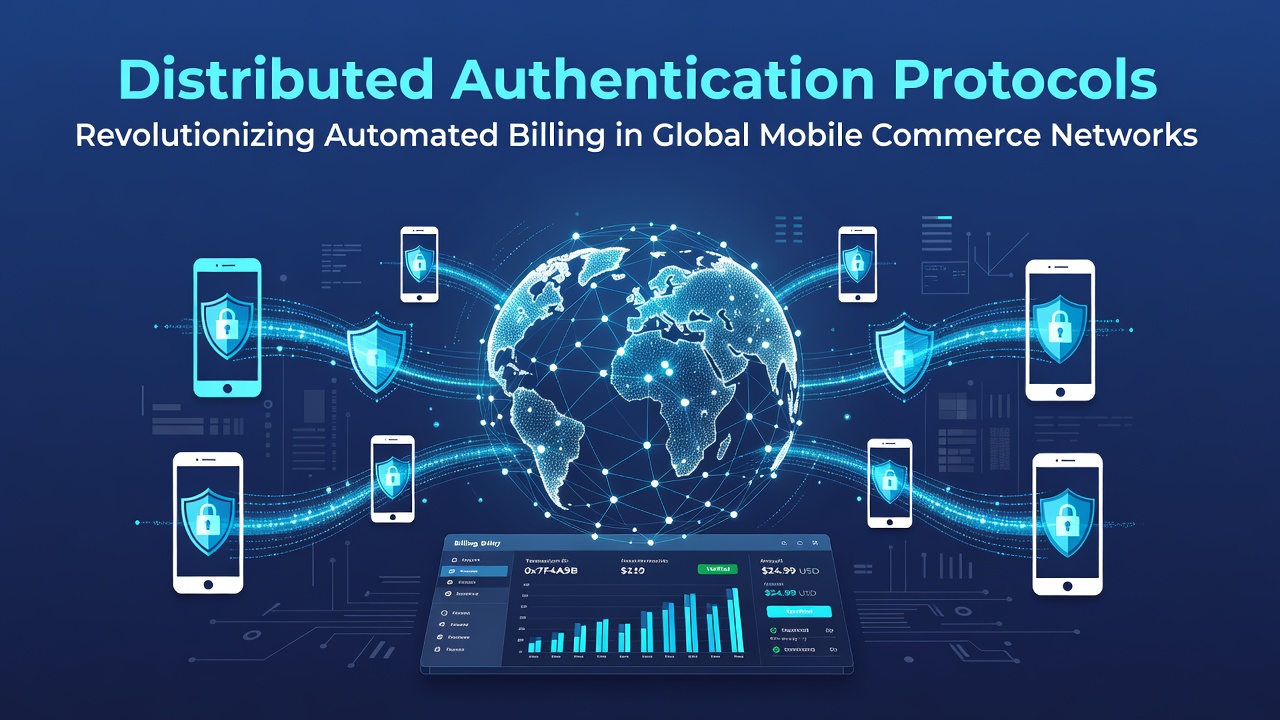
Distributed Authentication Protocols Revolutionizing Automated Billing in Global Mobile Commerce Networks
Distributed authentication protocols now handle verification across multiple network nodes in automated billing systems for mobile commerce, and this approach allows seamless processing of recurring charges while users move between carriers and countries. Research from industry groups shows these protocols reduce single-point failures that once disrupted subscription renewals during international roaming. Data collected through 2025 indicates adoption rates climbed steadily as mobile commerce volumes expanded in both developed and emerging markets.
Core Mechanisms in Distributed Verification
Protocols such as extended versions of Diameter and federated OAuth frameworks operate by sharing authentication tokens across edge servers rather than routing every request back to a central database. When a subscriber initiates a purchase on a mobile app, the local node validates credentials against cached policy data and then synchronizes the result with partner networks. This method cuts latency by up to 40 percent according to measurements reported by network operators in North America and Asia-Pacific regions. Observers note that the same architecture supports real-time deduction of small recurring fees without requiring repeated user input.
Integration with Mobile Commerce Platforms
Automated billing engines connect directly to these distributed verification layers so that charges for digital content, cloud services, and in-app subscriptions execute once identity checks clear. In practice, a user in Europe who travels to South America continues to receive seamless renewals because authentication policies replicate across regional clusters. Figures released by the GSMA in early 2026 highlight that over 65 percent of tier-one mobile operators had deployed at least partial distributed authentication stacks by the end of the prior year. Such deployments enable vendors to maintain consistent billing cycles even when network conditions fluctuate.
Security Enhancements Across Borders
Multi-factor elements including device-bound cryptographic keys and behavioral analytics now distribute alongside core authentication data. A node in one jurisdiction can request supplementary confirmation from another without exposing full user profiles, which aligns with privacy regulations in multiple regions. The National Institute of Standards and Technology updated its digital identity guidelines in August 2026 to include specific recommendations for these distributed models in commerce environments. Those updates emphasize mutual authentication between billing gateways and mobile devices to prevent replay attacks during automated charge cycles.

Case studies from operators in Canada and Australia demonstrate that fraud incidents tied to billing authorization dropped noticeably after full rollout of these protocols. The systems flag anomalies by cross-referencing activity patterns stored at multiple points rather than relying on a single log repository. This distributed monitoring approach also speeds recovery when localized outages occur because neighboring nodes assume verification duties automatically.
Operational Impacts on Global Networks
Scalability improves because new billing partners can join the ecosystem through standardized protocol interfaces instead of custom integrations. A vendor in one market gains access to subscribers in another once mutual authentication agreements activate across the distributed framework. Reports compiled by academic researchers at technical universities in the European Union show transaction success rates exceeding 99.2 percent for automated renewals when these protocols govern the flow. The same studies track reductions in manual intervention required from customer support teams.
Network operators continue to refine policy synchronization intervals so that changes in user status propagate within seconds rather than minutes. This timing matters for time-sensitive subscriptions such as streaming add-ons or pay-per-use connectivity packages. Equipment vendors have introduced hardware accelerators that handle the cryptographic operations required by distributed nodes, further lowering per-transaction overhead.
Future Trajectory Through 2026 and Beyond
Standards bodies are finalizing extensions that incorporate additional context signals such as location consistency checks without centralizing raw location histories. These enhancements aim to maintain compliance across jurisdictions while preserving the speed of automated billing. Participation from regulators in the United States, the European Union, and Asia-Pacific economies ensures the protocols evolve with both security and commerce requirements in view. Continued measurement programs will document how these changes affect overall mobile commerce throughput in the months following the August 2026 guideline revisions.
Conclusion
Distributed authentication protocols have become foundational to reliable automated billing within global mobile commerce networks, and ongoing refinements keep pace with expanding transaction volumes and regulatory expectations. The architecture supports consistent verification across borders while limiting exposure of sensitive data. As operators complete remaining deployments, the systems continue to demonstrate measurable gains in speed, resilience, and fraud resistance.