Chain-Verified Recurring Charges Reshape Trust Protocols Across Digital Retail Ecosystems
Digital retail platforms began integrating chain-verified recurring charges during 2025, and by May 2026 adoption metrics from multiple markets showed measurable shifts in how subscription renewals and automated billing cycles establish consumer confidence. These systems record each recurring transaction on distributed ledgers so that every charge carries an immutable timestamp and cryptographic signature that participating nodes can audit in real time.
How Verification Layers Operate in Subscription Workflows
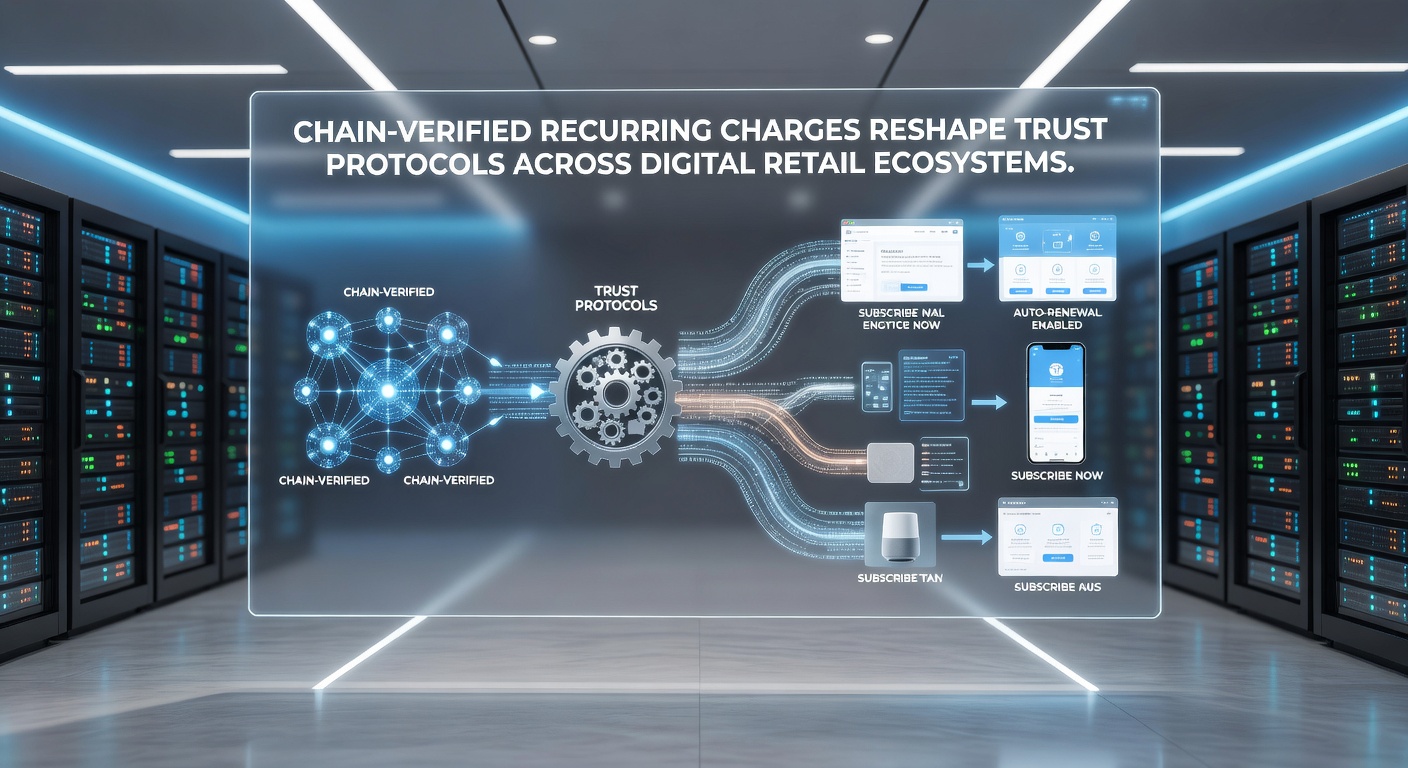
Retailers embed smart-contract triggers into billing engines, which means a consumer authorizes a recurring amount once and the ledger automatically validates subsequent charges against predefined rules before funds move. Observers note that this process reduces disputes because each node in the network confirms the merchant identity, the subscription terms, and the consumer consent hash before settlement occurs. Data from the European Payments Council indicates that verification latency dropped to under four seconds for most retail chains by early 2026, while reversal rates for unauthorized recurring charges fell by roughly eighteen percent compared with the prior year.
Merchants that adopted the protocol also gained access to shared trust registries maintained across several jurisdictions. When a consumer initiates a subscription on one platform, the ledger entry becomes visible to other participating retailers, allowing them to reference the same consent record without collecting duplicate authorizations. This shared registry model connects retailers in North America, the European Union, and parts of the Asia-Pacific region through standardized data fields that regulators have begun to reference in compliance guidelines.
Changes to Consumer Trust Mechanisms
Trust protocols have moved beyond traditional password resets and one-time codes toward continuous verification anchored in the ledger. Consumers receive a notification each time the chain confirms a recurring charge, yet the actual settlement happens only after multiple independent nodes reach consensus. Research published by the University of Toronto’s blockchain research group shows that users exposed to these notifications reported higher perceived control over their billing relationships, even though the underlying authorization remained unchanged.
Retailers meanwhile observe fewer chargeback requests because the ledger supplies an auditable trail that card networks and banks can query directly. In practice this means a consumer who questions a charge can receive an instant export of the consent transaction, the merchant signature, and the exact timestamp, all signed by the network rather than generated by a single company database.
Retail Ecosystem Adjustments and Regulatory Context
Platform operators have begun redesigning checkout flows so that the initial subscription setup includes a visible ledger preview. Shoppers see a summary of the smart-contract terms, the participating node count, and the estimated settlement window before they confirm. This preview step replaced older terms-of-service walls in many high-volume subscription categories, including streaming services, software-as-a-service tools, and recurring grocery delivery.
Regulators in several regions have started issuing guidance that treats chain-verified records as acceptable evidence in consumer disputes. The Monetary Authority of Singapore released updated digital payment standards in March 2026 that explicitly recognize distributed-ledger receipts for recurring transactions, while the Australian Competition and Consumer Commission incorporated similar language into its e-commerce enforcement priorities. These moves create a patchwork of recognized standards that multinational retailers must navigate when expanding subscription offerings.
Smaller merchants gain indirect benefits when they plug into the same verification networks used by larger platforms. Instead of maintaining separate fraud-detection teams, they inherit the consensus security of the shared ledger, which lowers operational costs and allows them to offer recurring billing options that previously required enterprise-level infrastructure.
Technical and Operational Considerations
Implementation still requires retailers to map existing billing systems onto ledger-compatible data structures. Many platforms accomplished this through middleware layers that translate traditional database entries into signed ledger transactions without replacing core accounting software. The transition period typically spans eight to twelve weeks for mid-sized operations, according to implementation reports shared at industry forums in early 2026.
Energy consumption questions have surfaced because some ledger networks still rely on proof-of-work validation. Several retail consortia therefore shifted to proof-of-stake or permissioned variants that cut energy use per transaction by more than ninety percent while preserving the auditability that drives trust gains. Observers tracking these migrations report that the majority of digital retail chains now operate on lower-energy consensus models for recurring-charge verification.
Conclusion
Chain-verified recurring charges continue to influence how digital retail ecosystems manage ongoing billing relationships and consumer trust. As more platforms connect to shared ledgers and regulators refine their acceptance criteria, the technical foundation for subscription commerce keeps evolving through verifiable, distributed records rather than centralized databases alone. The patterns established by May 2026 suggest that verification speed, cross-platform visibility, and regulatory alignment will remain central factors shaping future billing infrastructure.